Crypto-assets and Climate Change: Understanding the Carbon Footprint and opportunities to dampen it

I led a joint research project between the Central Bank of Hungary and CFTE, in collaboration with the Crypto Carbon Ratings Institute (CCRI), producing an industry report on crypto assets and sustainability.
The report assess the environmental impact of cryptoassets, outline data collection and measurement methodologies, highlight real-world sustainability initiatives, and explore potential regulatory frameworks.
I managed a team of three interns and coordinated with a central bank director and CCRI specialist to deliver the publication.
With Bitcoin consuming an equivalent amount of energy annually to some countries such as the UAE in 2021, it is time to speak of taming its environmental impact.
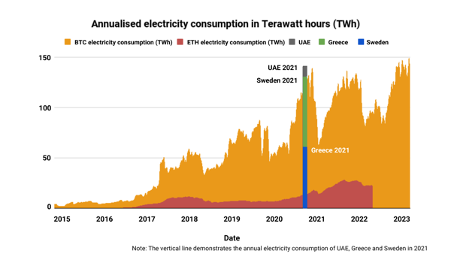
The report looks at the environmental and sustainability impact of crypto assets and ways to reduce it. Proof-of-Work (PoW) cryptocurrencies, which make up 80% of the market, use a lot of energy and produce about 95% of crypto-related emissions. Measuring this impact is difficult due to inconsistent methods and limited data. The roundtable highlighted the need for clear, standardised reporting to support better regulation and decisions.
Case studies we explored show possible solutions, such as Ethereum's 2022 “Merge,” which cut energy use by 99.95% by switching to Proof-of-Stake (PoS). Other projects—Celo's carbon-negative blockchain, ConsenSys' Ethereum Climate Platform, NEAR's focus on governance and transparency, and Cardano's supply chain tracking—show how the industry is taking action.
Regulation discussions weighed tailored rules for crypto against the risk of slowing innovation, suggesting principle-based policies, energy labelling, and possible taxes. The report also notes that sustainability goes beyond carbon reduction, including financial inclusion, community impact, and social projects. Key actions include unified data standards, public education, joint sustainability tools, and testing new ideas in regulatory sandboxes. Overall, the report calls for industry-wide cooperation to align crypto growth with climate and sustainability goals.
Learn more about the report I contributed as a researcher.